
A "You Know What I Mean, Right?" Moment
This happened today, just over an hour ago.
I went to the bank to apply for a credit card. Halfway through the process, the account manager casually suggested: why not open a debit card with the same bank too? It would make paying off the credit card easier. Sure — since I was there anyway, I did both.
Card in hand, a problem appeared — to activate this debit card, it first needed an initial deposit, and the account the money came from had to be in my own name. The manager didn't spell this out directly. Instead, he very naturally guided me: just open Alipay, withdraw some money, and transfer it in.
The moment he said "open Alipay," something clicked in my head: what he wanted was not the Alipay route at all. What he wanted was money from an account in my own name, actually flowing into this account once. Alipay was simply the most convenient suggestion he had on hand. The core of the mechanism was those six words — "initial deposit from a same-name account" — and the channel itself could be swapped.
So I didn't go through Alipay. I opened another bank's app — let's call it Shanghai Bank — and made a transfer from an account in my own name. Activation complete.
Afterward, I kept replaying that "click" moment. What the manager described was an operation ("just withdraw from Alipay"), but what I heard was a rule ("it needs a same-name deposit"). Once you see through the action to the rule behind it, you're no longer tied to any one specific path. Switching to a same-name transfer from Shanghai Bank wasn't me being difficult — it was simply a cleaner channel: a pure interbank transfer between accounts in the same name, with a clear, direct money trail and no third-party payment layer in the middle.
This little action that almost nobody looks at twice is actually a door. What exactly is this deposit — unlimited in amount, but strictly same-name — verifying? Why does everything hinge on those two words, "same name"? Push open that door, and standing behind it is an entire machinery of banking trust that spans more than half a century.
Let me plant an easily overlooked point here, to be picked up later: many people assume that when you open a card at a domestic branch counter, with your ID checked face to face, activation should be done on the spot — so why does it still take a same-name deposit? The answer is that "identity verified" and "account activated" are actually two different things. The teller confirmed face to face that "you are you," but for this card to truly come alive — to be linked for repayment, to move money — the bank still wants to see a real sum of same-name money flow through it once, as proof that the account has entered an active state. The amount doesn't matter. What matters is that this same-name money really did flow through, once.
And to understand why banks came to care so much about this one transfer, we first have to go back to the starting point where they began to get suspicious.
I. How Banks Became What They Are Today, Step by Step
1970: Bags Full of Cash
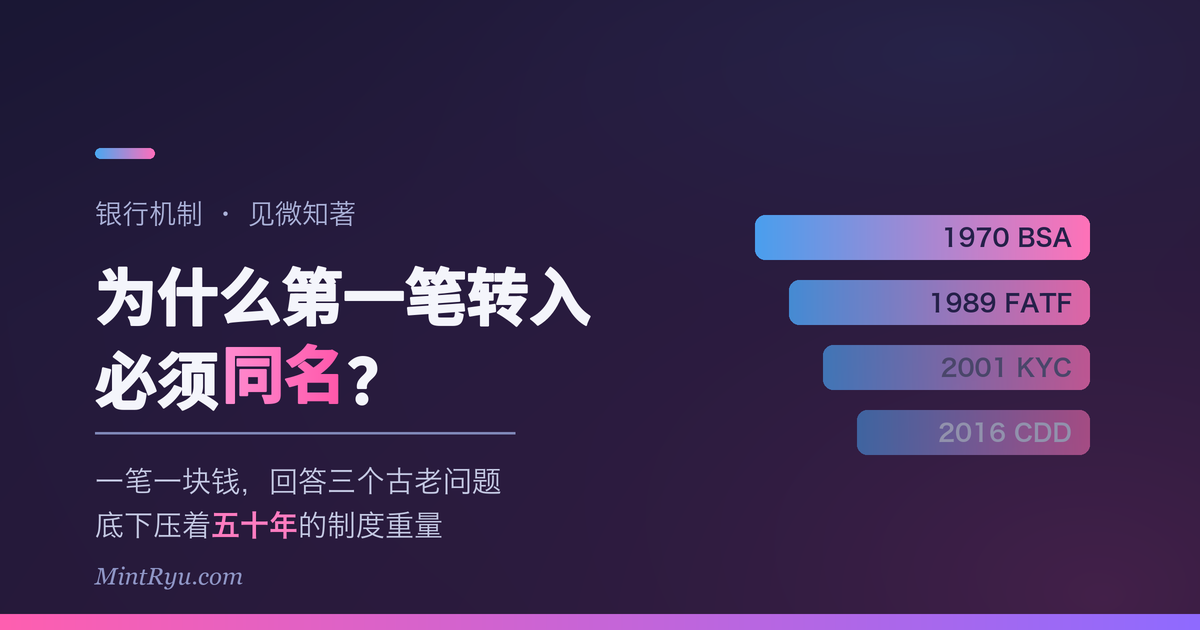
The story begins with a law passed by the U.S. Congress in 1970. Its formal name is long — the Currency and Foreign Transactions Reporting Act — but everyone knows it better by its other name: the Bank Secrecy Act (BSA).
The immediate reason for its birth sounds almost absurd: more and more people were walking into banks carrying bags full of cash of unknown origin to deposit, and banks had neither the obligation nor the ability to ask where the money came from. Congress realized the banking system was inadvertently becoming a "washing machine" for criminal proceeds.
What the BSA did, in essence, was give banks their first pair of "eyes": it required financial institutions to keep records of certain transactions, report large cash transactions over ten thousand dollars, identify the people conducting transactions, and file reports when they spotted suspicious activity.
A seed was planted here — from then on, banks had a legal obligation to figure out "whose money this is, where it came from, and where it's going." The fact that you need a same-name account today just to transfer one yuan traces back, at its root, to that seed.
1974 → 1988 → 1989: From One Country to a Global Consensus
If this logic had stayed within the United States, it would have been at most one country's rules. But finance flows, and so does crime — clamp down in country A and the money flows to country B. To truly plug the holes, banks around the world had to speak the same language.
Hence three key milestones. In 1974, the Basel Committee on Banking Supervision was founded, and banking regulators from different countries began sitting at the same table. In December 1988, the Basel Committee issued a dedicated statement on "the prevention of the use of the banking system for money laundering" — note that this was the first time regulators explicitly named "money laundering" as something banks had to guard against.
The real watershed was 1989: the G7 led the creation of the Financial Action Task Force (FATF). This body would go on to become the setter of global anti-money-laundering standards. From then on, "know your source of funds" and "verify your customer's identity" were no longer the domestic law of any single country, but the tacit, universal rules of global banking.
When you open an account in Hong Kong and have to fill in your source of funds, when any multinational bank puts you through a round of identity verification — standing behind all of it is the set of standards the FATF laid down in 1989.
2001: KYC Takes the Stage
What truly turned "verify your customer's identity" from a principle into a rigid process was 2001.
After September 11 that year, the United States passed the Patriot Act. Title III of that act required all financial institutions to establish internal anti-money-laundering programs and to adopt a "Customer Identification Program."
And it was from here that the abbreviation we all know today was born — KYC, Know Your Customer.
The core demand of KYC is actually remarkably plain: before opening an account for you, before lending to you, before letting you move money, a bank must first answer three questions — Who are you? Are you really the person you say you are? Is this money really yours?
Remember these three questions. Because in a moment you'll see that one small same-name transfer answers all three at once.
2016: Closing the Last Loophole
The evolution of the system didn't stop in 2001. In 2016, the Panama Papers leak exposed the widespread use of shell companies and anonymous accounts to hide assets, revealing a big hole in the existing rules: insufficient scrutiny of "who the real beneficiary behind an account actually is."
That same year, the U.S. Financial Crimes Enforcement Network issued the "Customer Due Diligence Final Rule" (CDD Final Rule), formally writing "piercing through to identify the account's actual controller" into the requirements.
And with that, a clear line is complete:
In 1970, banks were first required to "see the money clearly." In 1989, banks around the world began using the same standards to "see people clearly." In 2001, "know your customer" became a rigid process. In 2016, even the people hiding behind accounts had to be seen clearly.
Over more than half a century, the core task of banks quietly shifted from "safekeeping money" to "proving the innocence of every sum of money and every person."
And when this grand system finally had to land on "how exactly do we verify this one person on the other side of the screen," it needed a technical means that was cheap, hard to fake, and got everything done in one step.
The same-name transfer is that means.
II. What Does a Same-Name Transfer Actually Verify?
Now let's pull the camera back from fifty years of institutional history to the prompt on your phone screen: "Please transfer any amount from an account in your own name."
In the financial industry it has a dedicated name: the penny test, or the penny drop. The name comes from its most classic form: sending a tiny sum — one cent, one penny, one rupee — into an account, and using this actually-moving money to verify things that can't be verified any other way.
Its elegance lies in this: one action verifies several things at once. Let's take it apart.
First: The Account Really Exists — and It's Alive
The most basic layer. An account number might be fabricated, correctly formatted but nonexistent, or long frozen, closed, or dormant. But if a real sum of money lands in it successfully, that means the account not only exists but is in an active state, able to send and receive normally.
No "format check" can substitute for this. You can fake an account number that looks perfectly compliant, but you can't fake a transfer that actually arrives. The money made a real trip along real banking rails, and that result is almost impossible to counterfeit — this is exactly where the penny test beats simply checking an account number.
Second: You Actually Control This Account
This layer is cleverer, and it hides in the detail of "any amount."
Some implementations deposit a random small amount and then ask you to come back and enter "exactly how much did you receive." Being able to state that number accurately proves one thing: you really can see this account's transaction records — which is to say, you really control it.
A scammer who has stolen someone's account information may know the account number, but he can't see the few cents that just landed in it. This step draws a hard line between "knowing the account number" and "actually owning the account."
In the "same-name transfer activation" variant, the logic goes one step further — not a random amount, but a transfer out of an external account that bears exactly your name. Why is this so critical? The next section is devoted to it.
Third — and Most Crucially: The Names Match
When you transfer money in from "another same-name account," the receiving bank gets the account holder name registered on the sending account, and compares it against the name you registered with them.
Once the names match, those three core KYC questions are all answered in the same instant:
- Who are you? — The name is right here.
- Are you really the person you say you are? — Another bank verified the owner of this same-name account long ago, and now that money is flowing from there, it's as if that bank has vouched for you once.
- Is this money really yours? — It came from an account in your name; the money trail is clean and closed-loop.
You see, this is the real reason it "must be same-name." It isn't the bank being deliberately difficult. It's because only the "same name" condition lets this single transfer serve simultaneously as proof of identity and proof of source of funds.
Think about how much leverage is behind this: the bank where you're opening an account is, in effect, free-riding on another bank's due diligence. That same-name external account had its holder's identity, address, and source of funds verified by another institution back when it was opened. Now that money is flowing from there, the new bank doesn't need to investigate you all over again — it gets a pre-verified "trust anchor."
A one-yuan transfer connects into the trust network that the entire banking system shares with itself.
Incidentally, It Also Filters Out a Whole Class of Bad Actors
This mechanism has a quiet but powerful side effect: it naturally blocks the black market.
Buying and selling accounts, opening accounts under stolen identities, farming aged accounts — the common weak spot of these gray-market operations is that the operator usually cannot produce an external account that genuinely matches the new account's name and that they control to complete this step. An impersonator may know your ID number, but he cannot conjure up a bank account in your name that he can freely transfer from.
So this seemingly gentle "transfer one yuan" is actually a sieve, keeping a substantial share of fraud outside the door. The cost is minimal; the effect is very real.
III. Seeing the Big in the Small: The Weight of One Yuan
Back to this afternoon, to that "click" moment.
The account manager said "just open Alipay and withdraw some," but what I heard was the unspoken sentence behind it: give me money from an account in your name, let it actually flow in once. And it was at that moment that I realized what answers the foreshadowing planted earlier about "account activation" — why a transfer is still needed after identity has been verified: the verification establishes "you are you," while this same-name deposit activates "this account is trustworthy, usable, and able to move money from now on." Two things, done at once by a single transfer.
And my instinctive switch to a same-name transfer from Shanghai Bank was an extension of the same logic: once you see that what it wants is "the cleanest possible same-name money trail," you instinctively pick the channel with the shortest, most unimpeachable chain.
Now you know: this seemingly redundant deposit isn't a detour — it carries the weight of more than fifty years of institutional evolution.
Inside that sum of money are the bags full of cash from 1970, the global standards the G7 laid down in Paris in 1989, the whole process by which "know your customer" turned from principle into iron law after 2001. The bank asks you to make this transfer not because it needs the money, but because within this trust system that has been running for over half a century, it needs you to answer — with one action that is hard to fake, extremely cheap, and done in a single step — those three ancient questions on its behalf: Who are you? Are you really you? Is the money really yours?
This is why I've grown fonder and fonder of staring at small things like this. A manager's offhand "just withdraw from Alipay" looks utterly unremarkable on its own, but if you're willing to dig one layer down, you'll find that what lies beneath that transfer is the trust skeleton of the entire financial world. Those who see through it casually switch to a cleaner channel; those who don't just follow the instructions, finish, and forget.
Seeing the big picture in the smallest detail — that's really what this is about: the more an action is so everyday that nobody gives it a second thought, the more it tends to be the most honest cross-section of some vast mechanism. Ask one extra "why" today, and tomorrow you'll see this world with one more layer of penetration.
And that happens to be the best value one yuan can buy.
*This article grew out of a personal card-opening experience. The historical sections draw on public materials about the U.S. Bank Secrecy Act (1970), the founding of the FATF (1989), the Patriot Act and the KYC regime (2001), and the CDD Final Rule (2016); the mechanism sections are based on the industry-standard practice of the penny test / penny drop. Actual procedures vary by country and by bank; this article aims to explain the underlying logic and does not constitute any operational or compliance advice.*