
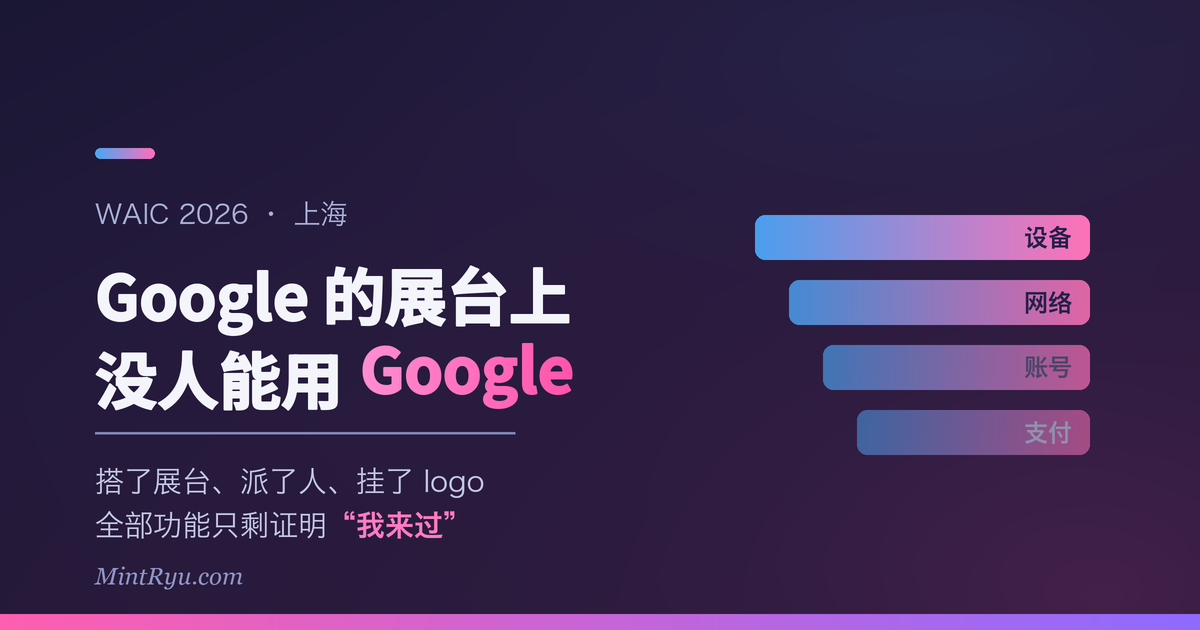
WAIC 2026, Shanghai World Expo Exhibition Hall. Google's booth wasn't small, and the decor was presentable.
A man in his thirties or forties walked over, a Huawei phone in hand, leaned in, and asked a staff member: how can I try Gemini?
The staffer's answer was short: "We're not currently offering services in mainland China. You could... find some other way."
That's it. One of the largest internet companies in the world, at one of the world's most cutting-edge AI expos, had set up a booth, sent staff, hung its logo — and yet it was the only exhibitor in the entire venue whose products visitors couldn't use, not a single one. The domestic large-model companies next door, however mediocre their products, at least let you scan a QR code and chat for a couple of lines. The company that built Gemini had a booth whose only remaining function was to prove "I was here."
The staffer couldn't even say out loud what "some other way" meant. A Google employee, standing at Google's own booth, using coded language to suggest a user circumvent the firewall to reach Google. Every layer of that sentence was understood without being spoken, by him and by the man asking.
I Butted In, and Got Half of It Wrong
I happened to be standing nearby and couldn't help chiming in: you could try a Hong Kong version Samsung — it comes with Gemini built in.
That was half right. The Hong Kong version of the Galaxy S25 does indeed come preloaded with full Google services, with Gemini as the default assistant, summonable by long-pressing the side button. But when I replayed the conversation at home, I realized the "built-in VPN" I had blurted out reflexively simply doesn't exist — no version of Samsung's phones has a built-in proxy capable of cross-border networking; Secure Wi-Fi is just encryption for public hotspots. So even if that man had actually bought a Hong Kong Samsung, the moment he inserted his SIM card, Gemini still wouldn't connect.
Let me also correct an even more common misconception: mainland-China Samsung phones have nothing to do with Gemini. The mainland S25's system-level AI goes to Samsung's own Bixby, underpinned by Zhipu's Agentic GLM plus Ernie Bot (文心一言), with DeepSeek-R1 added later as well. The same hardware crosses one customs border, and the entire suite of models living inside gets swapped out.
Four Walls
Only after replaying it all did I see the full shape of this thing. For an ordinary mainland user to actually use Gemini (or GPT, or Claude), they have to climb four walls in a row:
Device. The Huawei in his hand has no GMS; mainland Android phones across the board have Google services stripped out; the mainland iPhone's overseas AI features are blocked based on the network's home region. The first wall alone filters out the vast majority of phones on sale.
Network. Switch to a Hong Kong device and the network still doesn't work. You need to build or buy a proxy yourself — and no legal channel will openly teach you how, which is exactly why that staffer could only say "some other way."
Account. Registering a Google account requires a phone number that can receive verification and a clean network environment, and the registration channel for +86 numbers opens and closes unpredictably.
Payment. To use a paid tier like Gemini Advanced, you need a foreign-currency card or an overseas payment channel — a whole account-opening process of its own.
Four walls; break one and the chain breaks. My advice solved only the first. And for someone who had to make a special trip to the booth just to ask "how do I try it," any one of the remaining three was enough to make him give up.
This is the true shape of the barrier: it's not a wall, it's a chain. When people discuss whether Chinese users can access overseas AI, they habitually talk only about the network blockade, but the actual exclusion mechanism is the fourfold stacking of device, network, account, and payment. People like me who have all four pieces in place are a tiny minority, and every step of assembling them cost money, mistakes, and homework. It's not that the man didn't want to use it — it's that in front of him, not a single link of the chain connected.
Present, but Misfiring
The last thing worth recording is Google's own predicament. To keep Gemini in the default slot on overseas Samsung phones, this company pays Samsung enormous monthly fees plus a share of subscription revenue — a channel worth paying for. But in the mainland market, that playbook completely fails: the money goes to Samsung, and the mainland Samsung still can only ship Zhipu and Ernie. Channels, preinstalls, subsidies — every market weapon validated in the internet age misfires here, until all that's left is a booth and a single line: "find some other way."
I didn't see which booth the man wandered to afterward. But I'd guess he ended up opening some domestic app already installed on his phone — not because he chose it, but because it was the only one left.