
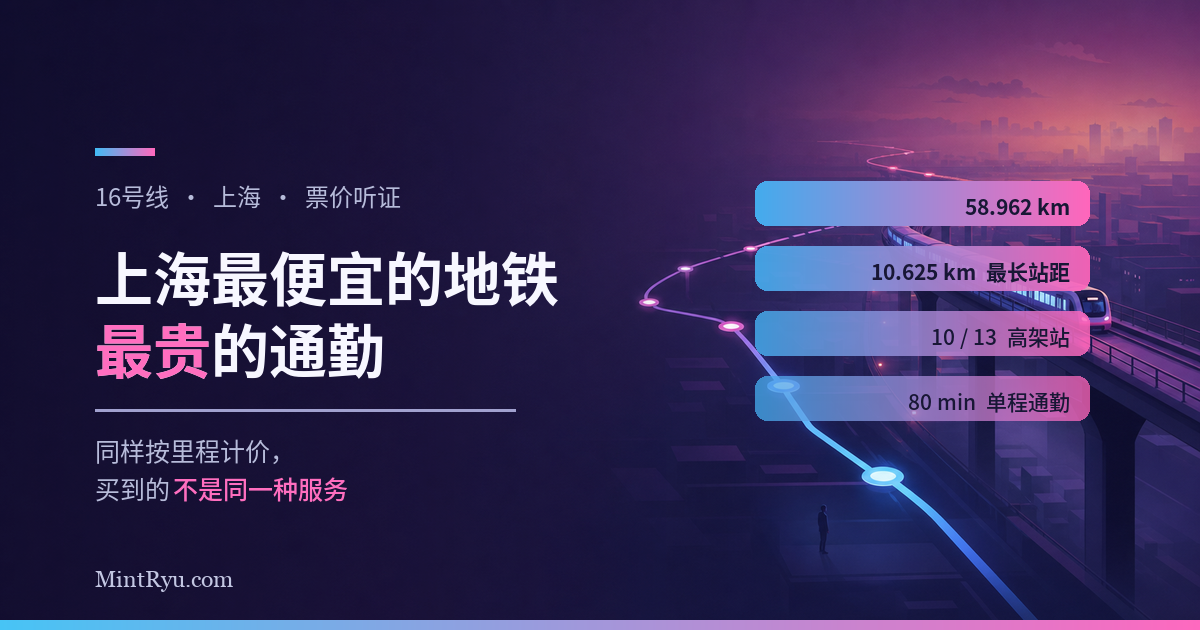
The service standard of Line 16 is the lowest on the entire network, but there is no such column in the pricing rules.
Longyang Road is the station with the largest passenger flow on Line 16, and it is also the gate through which Nanhui people enter the city.
To get off Line 16 and transfer to Line 2, you have to exit the station hall, pass through the entire transfer channel, and then walk through the station hall of Line 2 - this stretch of road is so long that you will wonder if you have walked out of the station. It happens inside a building, so it doesn't count in any statistics on commute times. After
, if you are returning, you will stand on the platform of Line 16. There is no air conditioning.
is not broken, it has never been. Among the thirteen stations on Line 16, only Huaxia Middle Road, Huinan, and Lingang Avenue are underground stations with environmental control systems and therefore air-conditioning. The remaining ten—including the starting point, Longyang Road—are all elevated stations, and the design standard is natural ventilation. The reason why those three stations are underground is not to keep passengers cool, but because the lines pass through the Huaxia Road area, Huinan Town and the core area of Lingang New City. The elevated lines will cut into blocks and cause noise disturbance to residents, so they have to go underground.
The little air-conditioning you got at Huinan Station is because the houses in Huinan Town are blocking the road.
On September 7, 2026, Shanghai will hold its first rail transit fare hearing in 21 years. Before I get into how much more I should have paid, I want to be clear about what exactly this line is.
1. Admit one thing first
The current rule is 3 yuan for 0-6 kilometers, and 1 yuan for every 10 kilometers thereafter. The distance from Longyang Road to Dishui Lake is 58.962 kilometers, and the fare is 9 yuan.
is calculated per kilometer:
| Travel type | Mileage | Fare | Yuan/km |
|---|---|---|---|
| City center short distance | 6 km | 3 yuan | 0.50 |
| Longyang Road → Huinan | ~35 km | 6 yuan | 0.17 |
| Longyang Road → Dishui Lake | 58.9 km | 9 yuan | 0.15 |
The money Nanhui people pay per kilometer is less than one-third of that of short-distance passengers in the urban area. This is "decreasingly far away". Any argument that bypasses this figure to talk about price increases is untenable.
So this article is not going to say "we are already miserable". What I want to say is another thing: This fare table only has one variable, which is mileage. It doesn’t ask what kind of car you took, where you stopped, or how long you walked.
And Line 16 happens to be the line that least deserves to be treated like this.
2. The same plan, cut in half
During planning and construction, Line 16 was named "Shanghai Rail Transit Line 11 Southern Section".
A plan was cut: the northern half became Line 11, and the southern half became Line 16. This is a very rare control sample - the starting point is the same but the end point is different. The first phase of
Line 11 has a total length of 46.008 kilometers, including 21.676 kilometers of underground lines and 22.283 kilometers of elevated lines. It has 9 elevated stations, 11 underground stations, and 1 ground station. The total project investment is 18.95 billion yuan. The second phase is 22.886 kilometers long with an investment of 12.965 billion yuan. The entire line is 82.4 kilometers long and has 39 stations, 23 of which are underground.
Line 16 has a total length of 58.962 kilometers, 13 stations, 3 underground and 10 elevated, with a total project investment of 18.16 billion yuan.
The first phase of Line 11 costs 412 million yuan per kilometer, and the cost per kilometer of Line 16 is 308 million yuan.
The two halves of the same plan, the southern half, cost 25% less per kilometer.
3. Among the five new cities, the one built four years later
Line 11 passes through Putuo, Changning, and Xuhui, and the central city section has increased its cost. This confounding factor must be acknowledged. So a second sample is needed - a purely suburban new-town radial.
Line 17, also known as Qingpu Line, opened to traffic in 2017, four years later than Line 16. It serves Qingpu New Town. Qingpu New City and Nanhui New City are both among the five major new cities in Shanghai, and have the same set of policy indicators for population introduction. The sentence "different densities lead to different standards" does not make sense between these two lines.
| | Line 16 (2013) | Line 17 main line (2017) |
|---|---|---|
| Total length | 58.962 km | 35.341 km |
| Number of stations | 13 | 13 |
| Underground station | 3 (23%) | 7 (54%) |
| Average station distance | ~4.9 km | 2.898 km |
| Maximum station distance | 10.625 km | — |
| Total project investment | 18.16 billion | 17.474 billion |
| Cost per kilometer | 308 million | 494 million |
| Full fare | 9 yuan | About 6 yuan |
| Fare per kilometer | 0.153 yuan | 0.170 yuan |
Put the two numbers together:
The cost per kilometer, Line 17 is 60% higher than Line 16. The fare per kilometer is almost the same for both lines.
Seven of the thirteen stations in Qingpu are underground and air-conditioned. The stations are less than three kilometers apart and can be walked from home. Ten of the thirteen stations in Nanhui are on elevated roads and have no air conditioning. The average distance between stations is nearly five kilometers. The section from Shuyuan to Huinandong is 10.625 kilometers, which is the longest distance between stations in Shanghai rail transit - that is not a distance that can be walked, but a distance that requires riding a battery scooter.
With the same unit price per kilometer, you are not buying the same thing.
4. Break down the phrase "lowest service standards"
Among all lines priced according to urban line fares, Line 16 ranks last in these five categories:
First, elevated stations account for 77%. Ten elevated stations have no platform air conditioning, the highest proportion in the entire network.
2. The average station distance is nearly 5 kilometers. Line 17 is 2.898 kilometers, and the city center lines are generally around 1.2 kilometers. The large distance between stations means that the "last mile" is all outsourced to the passengers themselves - the two oceans of battery cars outside the Hangtou and Academy stations are a direct result of this design. The academy is particularly typical: it is connected to the longest station distance in Shanghai at 10.625 kilometers. There is no alternative option to enter the city within a radius. Everyone can only ride here and leave the car on the roadside.
3. Long-term use of 3-section grouping. 16A01 train specifications are A-type cars, but each car only has 3 pairs of doors. The efficiency of loading and unloading passengers is naturally lower than that of the standard A-type car with 5 pairs of doors. At the beginning of the opening, it was organized into 3 sections, and later it was made up of 6 sections by reconnecting two columns.
4. Half-height safety door, not a fully enclosed screen door. This is also the physical premise that the platform cannot be air-conditioned.
5. The one-way commute takes nearly 80 minutes. The direct train takes 37 minutes, but only runs four times every weekday. The vast majority of people take ordinary buses that stop at every stop, plus the connecting time between the two ends. A round trip of 160 minutes a day, 22 working days a month, is 58 hours - equivalent to seven extra days of free work per month.
And these 80 minutes do not include the transfer walk at Longyang Road Station. The platform of Line 16 is on the elevated third floor, located at the southernmost end of this giant hub; the station hall of Line 2 is on the ground floor, and the platforms of Line 7 and Line 18 are underground - every time you enter the city, you have to walk a long way inside the building. It doesn't count against any of the operator's time metrics, but it happens twice a day.
None of these five items means "the operator does not work hard". They were written down in the drawings when the project was initiated in 2010. The judgment at that time was: the passenger flow in Nanhui is not large, the elevated highway is enough, and the three-car train is enough. A wider station distance will save money.
The cost of this judgment will be borne by the people who currently live here.
In five or six years, passenger flow has not increased
Lingang New Area's own "Comprehensive Transportation "14th Five-Year Plan" states: In 2020, the average daily passenger volume of Line 16 on weekdays will be 221,100.
The number given in public reports in 2026 is an average of 220,000 passengers per day.
Six years. The permanent population of Lingang is increasing all the time, and the passenger flow of Line 16 has almost remained unchanged.
(The caliber of the two figures may not be exactly the same. One is "daily average on working days" and the other is "daily average". I did not find STO's branch annual report to verify. But even if there is a difference of a few percentage points, this line has not appeared commensurate with population growth in six years. The direction of passenger flow growth is clear. )
If this is true, it can only point to one of three things: the line capacity has reached its peak, the population import is not as planned, or the degree of localization of employment in Lingang is higher than expected-people are coming, but they are not entering the city.
None of these three situations supports the premise of "adjustment of demand through price leverage". For a line with zero passenger flow growth for six years, the story of price elasticity does not make sense.
6. Arithmetic under price increase plan
The formal plan will not be announced until before the hearing on September 7. But the direction of the reform is already clear: Kunming will shorten the interval between step-up pricing in 2025, Chongqing will shorten the starting price mileage in 2026, and Guangzhou will include optimization of the fare mechanism in its major task list in 2026. The common action across the country is to activate the gear-jumping structure, with compression increasing and decreasing**.
In other words, the target of reform is long-distance passengers.
is calculated based on the 58.962 kilometers from Longyang Road to Dishui Lake:
| Rules | Fare | Monthly expenditure (22 working days round trip) |
|---|---|---|
| Current: Starting from 6 km, +1 yuan for every 10 km | 9 yuan | 396 yuan (approximately 363 yuan including 10% discount) |
| +1 yuan per 8 km | 10 yuan | 440 yuan |
| +1 yuan per 6 km | 12 yuan | 528 yuan (approximately 482 yuan including 10% discount) |
| According to the city line rate of 0.37 yuan/km | 22 yuan | 968 yuan |
changes the gear-hopping interval to 6 kilometers, and pays about 1,430 yuan more per year. The last line of
is not alarmist. Shanghai has set separate rates for municipal lines in 2024: 0.37 yuan per passenger kilometer for lines with a speed of less than 120 kilometers per hour, 0.45 yuan for 160 kilometers and above, and a starting price of 4 yuan. The physical attributes of Line 16 - 59 kilometers, nearly 5 kilometers station distance, and a maximum speed of 120 kilometers per hour for newly purchased trains in 2026 - are essentially a city line. When it was opened to traffic in 2013, Shanghai did not yet have the price category of "city line", so it was inserted into the pricing system of the city line.
This hearing clearly does not include the municipal airport line and the city lines that will be opened in the future. Line 16 is within the scope and will not be removed in the short term. But if the direction of the "optimization mechanism" is to flatten decrement, that's a slower version of the same thing.
7. Two ledgers
The Lingang New Area is a national-level strategy, and population introduction is a hard target.
While the city is issuing talent subsidies, house purchase subsidies, and rental subsidies to push people to the south, it is also using a fare mechanism to increase the cost of entering the city from the south.
These two amounts of money go through two ledgers, but fall on the cash flow of the same person.
Fourteen hundred dollars a year won't make anyone move. But it is a signal, and the signal will be read: You want people to settle in Lingang, and at the same time you increase taxes on commuting to Lingang.
This is not a complaint, it is a point out a financial conflict between the left and right hands.
8. So what should I ask?
In 2026, Line 16 will undergo a 353 million yuan renovation to improve efficiency and energy: CRRC Zhuzhou Locomotive won the bid for about 291 million yuan to add 6 new 6-group A-type cars with a top speed of 120 kilometers per hour. The first train has been delivered in the first half of the year.
The money was spent on "faster" and not on "more comfortable". Not a penny was spent on platform enclosures or air conditioning.
The fare reform is talking about the price range corresponding to "more comfortable".
So the real question that should be asked at the hearing is not "can it not be increased?", but these three sentences:
First, if the fares are going to be closer to the city line standards, when will the service standards of Line 16 be closer to the city line standards? Is there a timetable and budget for the air-conditioning renovation of ten elevated stations?
Secondly, why is there no service level column in the fare rules? With the same unit price per kilometer, you can buy an underground station with a station distance of 2.898 kilometers, or an open-air station with a station distance of 10.625 kilometers. A watch that only recognizes mileage is itself a pricing mistake.
Third, publish the cost, passenger flow and subsidy data of branch lines. The overall financial status of Shanghai Metro has not been publicly disclosed so far. The operating costs, ticketing revenue, and financial subsidy amount of a single line of Line 16 are all black boxes. Asking the public to express their opinions at a hearing on "cost-based pricing" without providing a cost monitoring report is an empty discussion.
incidentally has a technical requirement: in the second announcement, please publish the absolute increase calculation of "new plan compared to current fares", not just the relative difference of "plan one vs. plan two". What was given during the hearing on the municipal line in 2024 was that "the overall ticket expenditure of option two is 3.3% higher than that of option one" - no one saw the comparison with "no increase" throughout the process.
Tail
I'm not opposed to price increases. The essence of diminishing returns is that short-distance passengers in urban areas are subsidizing long-distance passengers in outer suburbs. This subsidy is not justified.
What I object to is using a table with only one variable, mileage, to price a product with a huge difference in service level.
Thirteen years ago, someone made a judgment for Nanhui: there are not many people here, the elevated highway is enough, three cars are enough, and the distance between the stations is wider to save money. The money saved by this judgment is now reflected in the cost list as a decrease of 186 million per kilometer.
Now we need to make up for the fare, can we first make up the 186 million.
*Data sources: Shanghai Municipal Development and Reform Commission Hearing Announcement (July 29, 2026), Shanghai Metro official website line information, Wikipedia line entries, Lingang New Area Comprehensive Transportation "14th Five-Year Plan", China Urban Rail Transit Association's "Urban Rail Transit 2025 Annual Statistics and Analysis Report". The cost data are based on work approval standards, spanning 2010-2017, without price deflation; based on actual purchasing power, the gap between Line 16 and the other two lines should be greater than the figures in the article. The investment amount of Line 17 is another 17.362 billion yuan, and this article takes 17.474 billion yuan. *