

Some background first: I've done DSP plugin development and written some audio-related software.
Every interface mentioned in this article — the MidiPlus R1, Studio Pro OTG, R2, Topping, "Brand K", "Brand W", ESI, MOTU M5, RME Babyface, and Antelope's Zen Quadro, Zen Q, Zen Tour and D4 — was bought with my own money. Not a single one was a review unit sent by a manufacturer.
So this isn't a review, and it isn't a recommendation list. It's just one user laying out years of accumulated experience. You're welcome to disagree, but every conclusion here comes from plugging the thing in, turning it on, and recording with it myself.
The spec sheet is this industry's biggest illusion
There's a strange phenomenon in the audio interface world: everyone talks about specs. How many dB of dynamic range, how many zeros after the decimal point in THD+N, what the EIN is. Cookie-cutter reviews especially love this stuff, because the specs are handed to them by the manufacturer — copy them once and you've met your deadline.
But the things you actually deal with every day don't get a single word on the spec sheet: whether the driver suddenly vanishes, whether you can make sense of the routing interface, whether it still recognizes your system after a Windows update, whether it has enough gain when you plug in a dynamic mic.
Those are the things that decide whether you enjoy using the device — and they're exactly where so many reviews gloss over the details.
On the RME Babyface: the other side of the driver god
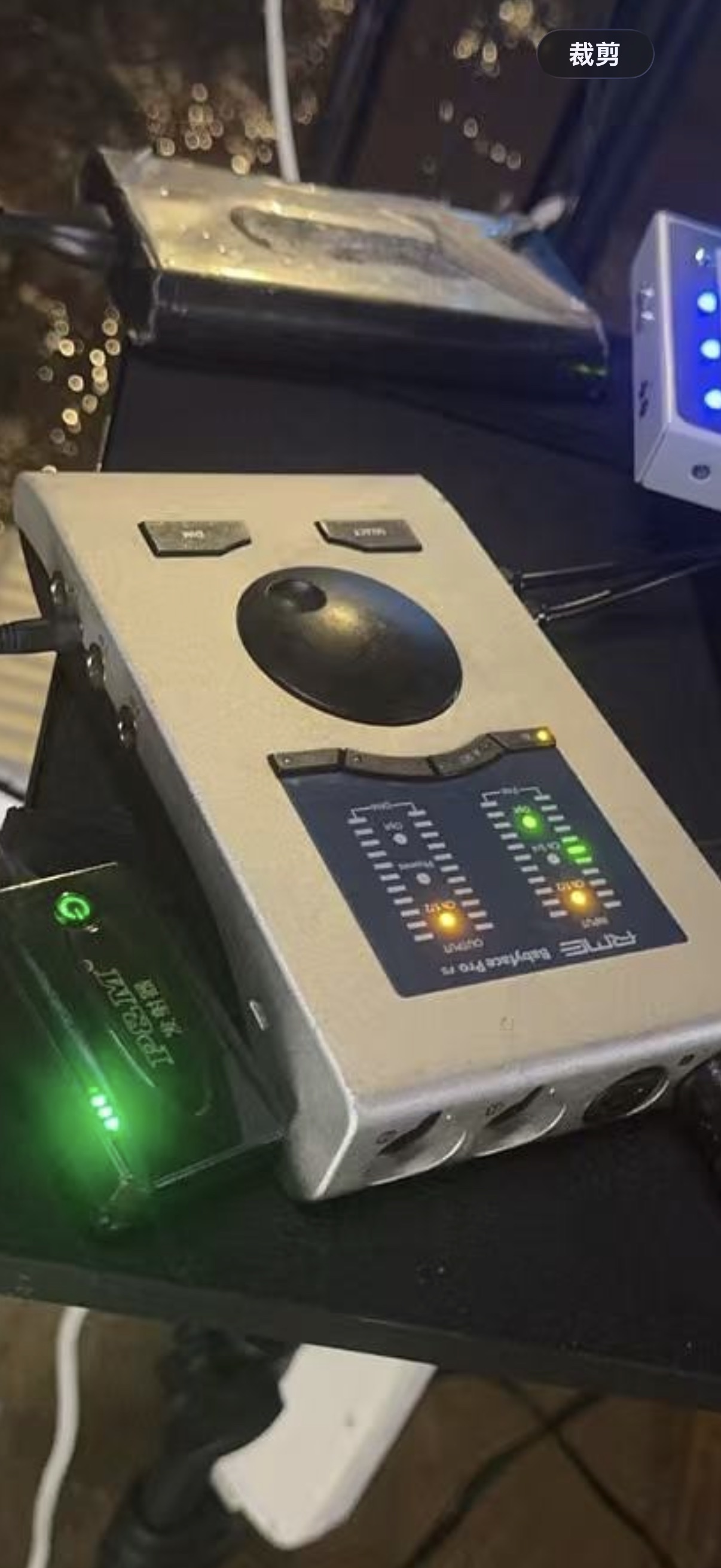
On the Chinese internet, the Babyface is practically beyond criticism: "the best drivers on earth," "buy it once and you're set for life." My takeaway after using it: at this price, the hardware doesn't hold up.
Let me get specific on two points.
First, hardware quality. With the same SM7B, both the Zen Quadro and the D4 have a lower noise floor than the Babyface. The SM7B is notoriously gain-hungry, which makes it one of the most demanding tests of a mic preamp. When a significantly cheaper unit wins on this front, the "you get what you pay for" story falls apart.
Second, that deified driver. TotalMix is genuinely powerful, but the price of that power is complexity: an unfriendly interface and convoluted routing logic that very easily tie non-technical users in knots.
I've seen plenty of customers buy an RME and be completely helpless the moment something small went wrong. Little glitches after Windows updates are, in my actual experience, not rare at all. "Rock-solid drivers" reads more like a legend that's been circulating so long that hardly anyone re-verifies it.
Whether a driver is good shouldn't be measured only by the ceiling of its features, but also by how long it takes an ordinary person to become productive with it and whether they can rescue themselves when something breaks. By that standard, the Babyface fails.
On Antelope: the most unfairly trashed company on the internet
Search for Antelope (羚羊) on the Chinese internet and you'll be told: driver disasters, dropped drivers, after-sales nightmares.
A disclosure first: my first encounter with Antelope happened because a friend worked at Antelope's master distributor in China, and I bought my first unit at an internal price. So you're fully entitled to read this section with skepticism. But precisely because I got it cheap, I have no psychological burden of "I spent big money, so I have to say it's good."
I've used Antelope for six years — Zen Tour, Zen Q, Zen Quadro, D4, rotating through their products — and I have never once had a driver drop. Not once. Ironically, it's the driver-deified RME that occasionally acts up after a system update.
And Antelope's control software is among the most intuitive I've used: simple interface, clear routing, basically no manual needed to get going. That's a completely different world from its online reputation.
I don't know whether those reviews are historical baggage from early legacy models or something else. But at least judged by my six years of heavy use, the company has been wronged. Hardware quality, as I said earlier: noise floor beats the Babyface, at a friendlier price.
"Brand K" and "Brand W": preying on first-time interface buyers
I'm using anonymized names for these two — those who know, know. I dare draw this conclusion because I haven't just used their products; back when I worked in the industry, I sold them — and the margins were considerable. Anyone in the channel knows the gap between a unit's cost and its price.
Based on my own experience using and selling them, their build quality, sound and driver experience don't live up to the price; they rely mainly on distribution channels and marketing to reel in beginners with limited budgets and no basis for comparison. First-time buyers are the easiest to trap, because they have no reference point and no idea what "normal" should look like.
If you've already bought one, no need to stress — if it works, keep using it. But if you haven't bought yet, the same money has clearly better destinations.
The underrated tier: Topping and the MOTU M5
Topping's interfaces and the MOTU M5 are the classic case of "no buzz, but the product is genuinely good." The hardware quality over-delivers at this price point; the drivers are simple and stable; with no flashy features come no flashy traps.
Maybe they never trend simply because the entire marketing budget went into the components.
MidiPlus R1: sincerity for 500 yuan
The R1 deserves its own section. My reason for buying it was very practical: I had to go to school, and I couldn't exactly lug a MOTU or an Antelope between the dorm and the classroom. It's the cheapest item on this list, and also one of the most pleasantly surprising.
500 yuan — the hardware performance is genuinely weak, let me be clear about that up front: don't expect studio-grade sound. But here's what it gives you: an extremely simple, intuitive driver, OTG support, a 3.5mm headphone/mic jack, and even direct connection to a phone.
A 500-yuan interface that nails "usable, pleasant, usable anywhere" to this degree knows who it's for better than many products several times its price.
It's candid about where it's weak and where it's strong. In this industry, that's a rare quality.
Finally
This isn't a buyer's guide, and I don't want to hand you a "buy with your eyes closed" list. I just want to say one thing: this industry's evaluation system is, to a large degree, co-constructed by reviews and faith, and there's a long distance between the spec sheet and lived experience.
If you take only one sentence away from this article, I hope it's this one: other people's conclusions — mine included — are just references. And the assumption that "expensive and famous means good" frequently fails in the audio interface category. What suits you is what's best.
Disclosure: All equipment was purchased out of pocket; the Antelope units were bought at an internal price, as noted above; I have no promotional relationship with any manufacturer.