
1. A popular saying
At the beginning of this month, a piece of news became a hot topic: a girl from Ganzhou, Jiangxi, who lives on a minimum living allowance, went to Hong Kong to watch a concert. When she came back, her family's minimum living allowance was cancelled. The details of the
online version are very specific. The girl is a technical secondary school student in Ganzhou. Her family is in a difficult situation, and her family lives on a subsistence allowance of about 2,000 yuan per month. She is obsessed with chasing stars, and uses her savings from part-time jobs during the summer and the subsidies she saves in daily life to scrape together 3,000 to 5,000 yuan to go to Hong Kong to watch her idol's concert. It is said that her family and support staff advised her before departure. After returning, the civil affairs department started a review based on her exit record, and the family's minimum living allowance was immediately cancelled.
On September 7, the official notification came out, and the content was different from the online version. The notification confirmed that the person involved was Huang Moumou, a resident of the jurisdiction. She went to Hong Kong to watch a concert on her own, which triggered a dynamic monitoring and early warning for subsistence allowance recipients. Community cadres subsequently promoted the policy and reminded her; her family members were worried that they would lose their subsistence allowance qualifications, so they posted online for help. The local government is checking according to procedures. In other words, as of the time of notification, the subsistence allowance has not been cancelled.
While watching and arguing, a theory began to spread: the country spent tens of billions to build a "monitoring system for the poor." If you are poor, you will be stared at; if you spend a sum of money that is not what poor people should spend, the system will come looking for you.
Let me make it clear first, I have not found the source of the number "tens of billions", and the relevant system does not disclose the total investment amount. But what I want to seriously discuss is not the money, but the judgment behind this statement: Can this system really "monitor" the poor?
My answer is: it is far less interesting than people think. Its problem is not that it sees too much, but that it cannot see the person it should most see.
2. What is this system?
The so-called "Poor Monitoring System" is officially called "Low-income Population Dynamic Monitoring Information Platform". It doesn't appear out of thin air. The Jinmin Project of the Ministry of Civil Affairs is a major national e-government project. It aims to solve the problem of fragmentation and fragmentation of civil affairs informatization construction. In the "14th Five-Year Plan" civil affairs informatization plan, the low-income population dynamic monitoring information platform is listed as one of the 10 key projects.
How it works is no mystery. Each province relies on the national social assistance information system of Jinmin Project and the local big data hub to build a unified platform across the province, with functions such as data collection, sharing, monitoring and early warning, and transfer push. The specific method is cross-departmental data comparison: cross-compare the low-income population data with data held by departments such as education, justice, human resources and social security, housing construction, agriculture and rural areas, health care, medical insurance, Disabled Persons' Federation, and courts to dynamically monitor the situation of the low-income population. The comparison results trigger rules, and the system generates early warnings and pushes them to the grassroots for verification.
Data can be cross-checked; life cannot.
is huge. As of the end of March 2024, 80.15 million people were monitored nationwide, accounting for 5.7% of the total population. There is one thing about
that is often overlooked: in the official design, early warning is two-way. If it is found that the rescue policy may be in line but has not been implemented in place, it must be included according to procedures; if it is found that it may no longer meet the conditions, it must be terminated according to procedures. Officials from the civil affairs department have also specifically emphasized that inclusion in monitoring does not mean providing assistance. The purpose of monitoring is to "prevent risks," so the scope of monitoring objects is larger than the actual assistance objects.
So, judging from the design drawings, this is a system that pays equal attention to "checking for leaks" and "checking for errors." It's not just about catching people who shouldn't be receiving money, it's also about finding people who should be receiving money but aren't.
The question is, what is between the drawings and the implementation?
3. What did it do in Ganzhou?
Return to Ganzhou. Looking at the online version and the official notification together, the system’s role in the whole thing is actually very limited.
It did what it could: an outbound record entered the comparison, hit the rule, and generated an early warning. According to Jiangxi regulations, self-funded outbound travel and entertainment is a high-consumption verification situation. If there is high consumption behavior during the period of inclusion in the subsistence allowance and no legitimate reasons can be explained, the assistance should be stopped. The system recognized an "event".
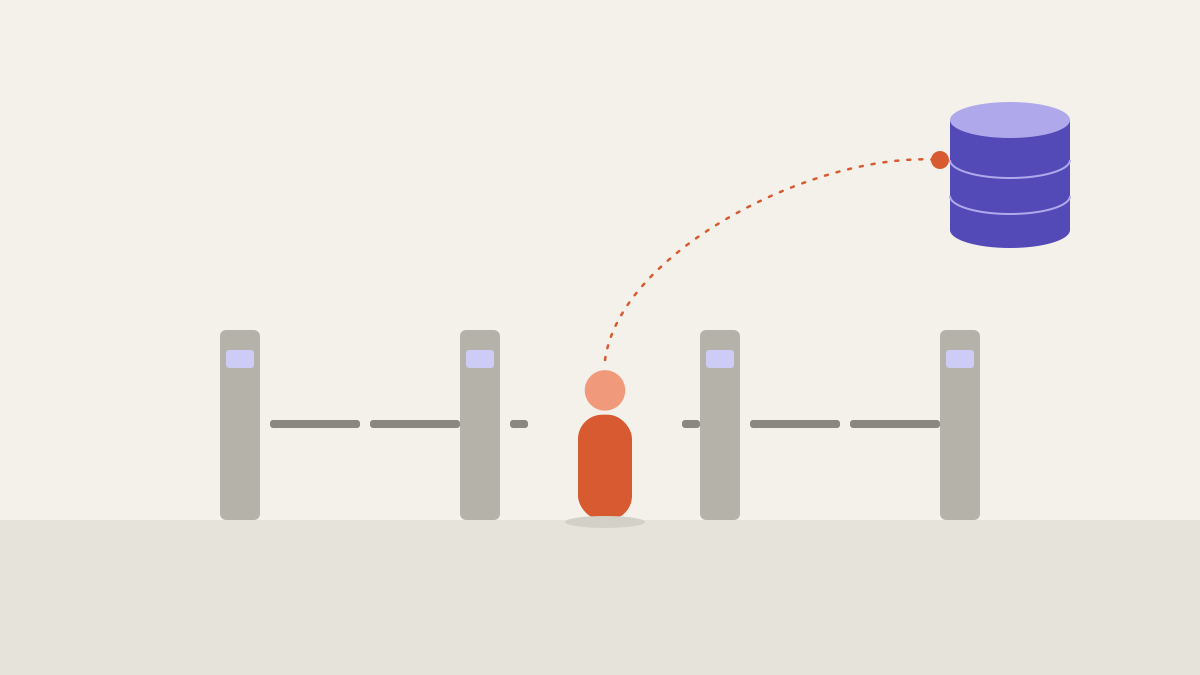
Every crossing is a record added to the database.
But that's all it can recognize. It doesn’t know who paid for the money, whether it was the subsistence allowance or the girl’s own work and savings; it doesn’t know who in the family is sick, who is old, and who is supporting it; it doesn’t know what this trip means to a teenage child. None of this information is in any department's database. After the
warning is generated, all the links that really determine the direction of the matter occur outside the system. When community cadres come to "policy publicity and reminders", what they say, how they say it, and whether their tone is advice or warning will not be recorded in the system. After hearing this, the family members understood that "the subsistence allowance is going to be gone." This was the first time they understood the difference. The family members posted a message asking for help. After being forwarded and titled, the public opinion spread it as "the whole family's subsistence allowance has been cancelled." This was the second deviation. From beginning to end,
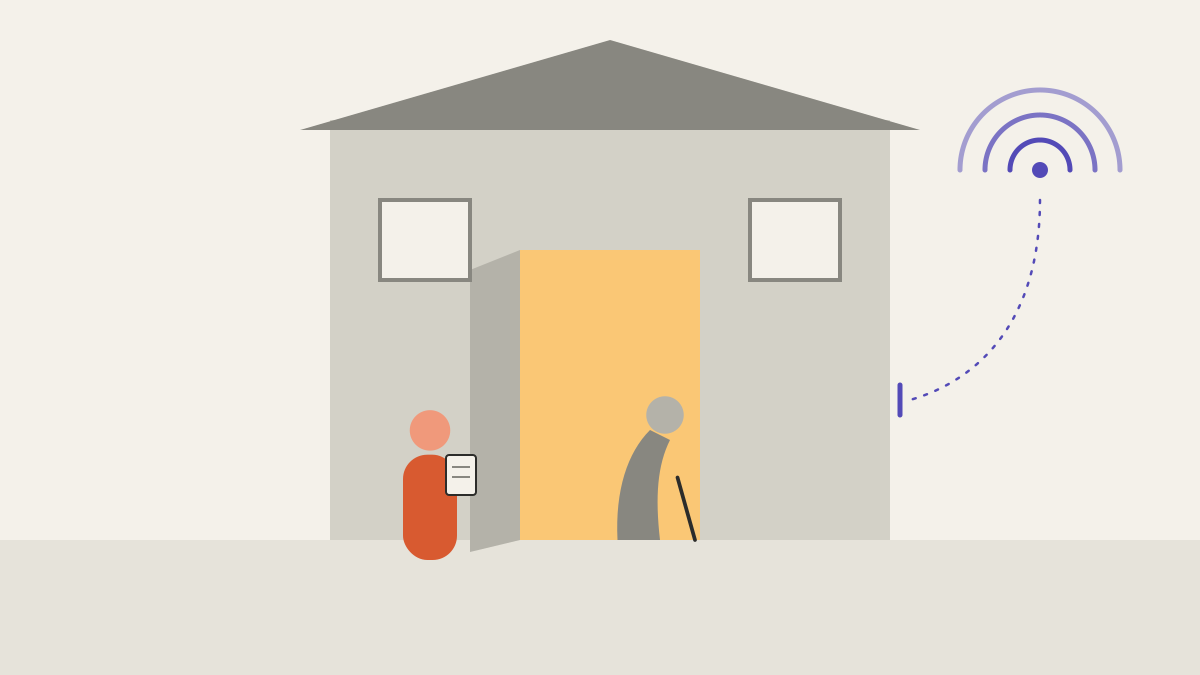
Everything after the alert happens behind a door like this.
, the system only contributes a signal. What follows is a series of human-to-human transmissions and interpretations, each of which may be distorted, and each of which is outside the system’s field of vision. A comment by
put it very accurately: Whether it is netizen supervision or civil affairs big data early warning, the significance of clues is to promote verification, rather than making direct judgments. Minimum living allowance eligibility must ultimately be judged on the family's true income, property and living burden. The question lies here: who will "return" to that reality? What to do?
4. Data is not collected, but translated.
The original intention of designing information management systems (MIS) is to allow management to see clearly what is happening at the grassroots level. It has a default assumption that is rarely spoken: data is "collected", like a thermometer reading temperature, and the actual conditions at the grassroots level are faithfully transmitted to the system.
But data in the field of social assistance is not generated this way. The extent to which an elderly person is disabled or the extent of a family's difficulties are not things that can be measured directly. They must be visited, listened, and asked by a specific person, who then translates the life they see into the options and numbers in the table.
The more accurate name for this process is not "acquisition", but "translation".
translation is bidirectional. Upward, grassroots staff translate a family's life into fields that the system can understand; downward, they translate the system's rules and conclusions into words that ordinary people can understand. In the Ganzhou incident, what the community cadre who came to the door did was to translate downwards, and the family members' misunderstanding showed that the translation was not successful.
Once "acquisition" is replaced by "translation", a problem emerges: what the management sees through the system is never the grassroots itself, but the grassroots in the eyes of the translator, filtered by the translator's ability, willingness and situation.
can then make the core judgment of this article: The visibility of information management systems has an upper limit, and this upper limit is determined by grassroots translators.
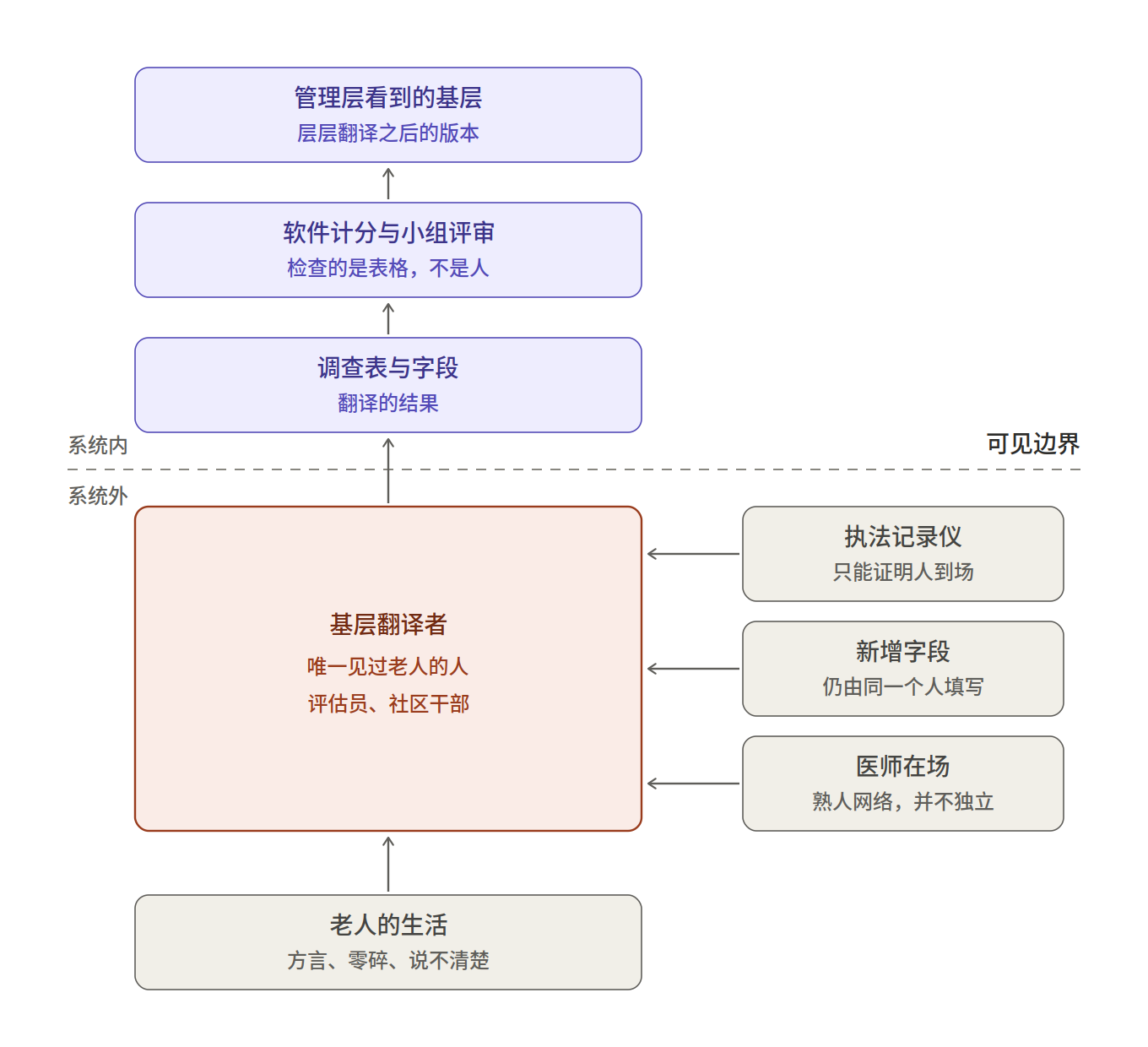
Everything that the system can see must first pass through the person under the dotted line. No matter how large the database is built in the
system and how detailed the comparison rules are written, for anything that requires people to judge on-site, how much the system can see depends on how much that person can and is willing to translate.
5. A sample to see more clearly: home assessment of long-term care insurance
In the case of minimum living security, only a corner of the translation node is exposed. Disability assessments for long-term care insurance provide a more complete sample because here, every aspect of the translation is clearer and the system adds more means to "see clearly."
Long-term care insurance is a system that the country has focused on promoting in recent years. In March this year, the national level issued opinions on accelerating the establishment of a long-term care insurance system, requiring the improvement of national unified disability level assessment standards, promoting national mutual recognition of assessment results, and encouraging the development of independent assessment agencies. Simultaneous advancement of informatization: The National Medical Insurance Administration introduced that it has relied on the national medical insurance information platform to launch a long-term insurance subsystem to support the informatization of the entire process of disability level assessment, fixed-point management, and cost settlement, and promote online order dispatch, door-to-door service smart check-in, and automatic recording of service hours. Some places are still piloting the use of millimeter wave radar for monitoring and early warning.
The starting point of this system is a door-to-door assessment. Whether an elderly person can enjoy nursing services and at what level depends on what the evaluator sees when he comes to the home.
The following is what I learned about the situation in one place. It was a suburb of a big city. It was originally a county and was later merged into the city to become a district. There are large areas of administrative villages sandwiched between towns, and the population is very aging. The person responsible for the door-to-door assessment of this large area is a team of about ten people.

It was once a county; later it became a district of the city.
Regarding this door-to-door visit, the system has added layers of "seeing clearly" methods.
The first step: law enforcement recorder. This place required assessors to wear recorders on the job about a decade ago. It can prove that the evaluator actually arrived at the site and went through the process. But it cannot prove whether the judgment itself is correct or not. Moreover, almost no one watches the video. It is only called out when there is a dispute and accountability needs to be held. Its actual function is not real-time supervision but delayed accountability: a talisman for the evaluator in normal times and evidence in times of trouble.
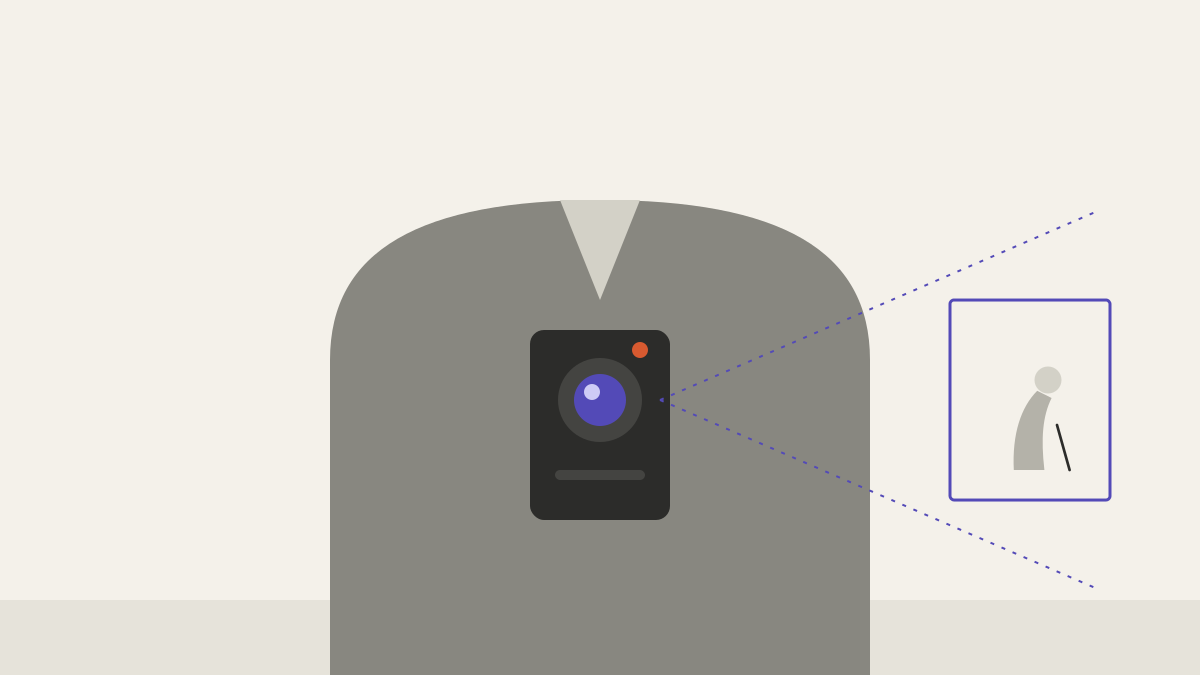
It can prove that someone came, but not what they understood.
Second Channel: The doctor is present. After the epidemic, the local requirement is that a licensed physician must be present at the assessment site. The logic of the system design is very clear: introduce a second observer with professional qualifications to confirm each other. However, most of these doctors are part-time, coordinated by community hospitals. They usually work in community hospitals, or they are retired medical staff who have been reemployed. In such a place, the medical circle is not large. The doctors and evaluators are acquaintances with each other, and the doctor may be a community doctor familiar to the elderly in the area. Two highly correlated observers provide nearly as much information as one person. The result is often that the physician "presences" and provides signatures and legitimacy rather than independent judgment.
Level 3: Software scoring and group review. The assessor fills out a standardized questionnaire on site, and the scoring software in the system automatically grades based on the questionnaire, which will then be reviewed by the review team. This looks like using algorithms and collective decision-making to hedge against individual biases. But both the software and the review team faced the same questionnaire, which was the result of on-site translation. They can check whether the table is internally consistent, but they cannot check whether the table is consistent with the old man's real life. In the entire link, only the two or three people who came to the door had actually seen the old man.
The translator itself is also invisible. Most of the members of this evaluation team have been working in this industry for many years. They were formerly units under the old civil affairs system and were later transformed into state-owned enterprises. The personnel vary greatly: there are retired doctors with doctorate degrees, as well as employees with secondary school degrees and limited written expression skills. But in the system's personnel classification, they may belong to the same category, fill out the same format of questionnaires, and receive the same treatment. The system cannot see this difference, so the assessment of the same elderly person depends to some extent on who comes to the door that day. This was a draw in which the parties did not know they were participating.
The person being translated is even more invisible. The elderly who are truly disabled and in real difficulties are often the ones least able to express themselves. If the evaluator calls and chats for half an hour, the other person may not be able to say a single key point; if they are asked to fill out the application online by themselves, they will not know how to do it at all. They don’t know what they can apply for, they don’t know the process, and they don’t know they can appeal if they have objections to the results. The evaluation conclusion has a validity period, and you need to reapply when it expires. If you miss it, the benefits will be automatically terminated, and no one needs to make a decision to refuse.
The people who can complain, appeal, and call repeatedly are often the ones who know the ropes and have the connections. Some of them are not really disabled, but just feel that they should get the money. Most of the feedback signals received by the system come from the latter. A system that relies on feedback to adjust is shaped bit by bit by the talking heads.
It is worth noting that the intelligent methods being promoted at the national level, such as clock-in, automatic timing, and millimeter-wave radar, are all aimed at whether the nursing services are actually delivered to the door and whether the service is completed for a full period, that is, "the presence or absence of the person." Technology can do little to make the most critical judgment at the assessment site.
6. Why adding fields is useless
Seeing this, a natural reaction is: make the system more detailed. Translation labor not recorded? Then add a "communication duration" field. Is the judgment process invisible? Then add a column "Situation Description". Are evaluators of varying abilities? Then add a set of quality assessments.
These improvements are technically easy to implement, but they all cannot avoid the same problem: Any new field will still be filled in by the translator himself.
The "communication duration" is filled in by the evaluator himself; the "situation description" is written by the evaluator himself; even for law enforcement recorders, the explanation after the video is retrieved still relies on the narrative of the person at the scene. The system wants to bypass the translator and look at the grassroots level, but every tool it has has to go through the same translator in the end. Look back at the picture above: the arrows of the three methods on the right all point to the same person.
This forms a closed loop: the person being supervised is also the person writing the supervision evidence.
In this closed loop, every additional layer of "seeing clearly" will bring two consequences.
First, the translation burden is heavier. A dozen people have to cover the entire Jiuxian County, and manpower is already stretched thin. Every additional field and trace requirement means less time is actually spent on the scene and listening to what the old man has to say. The added burden on the system to see clearly squeezes out the only part of the labor that allows it to see clearly.
Second, the record is more defensive. For every additional field, there is one more place where you may be held accountable. The rational approach of the evaluator is to make the records as standard and error-free as possible, rather than to reflect the truth as much as possible. As a result, the function of records has quietly changed: from describing reality and supporting judgment to proving that one is compliant. There is a ready-made word at the grassroots level to describe this state, called "traceism." The trace becomes an end in itself, and real judgment is squeezed out of the record.
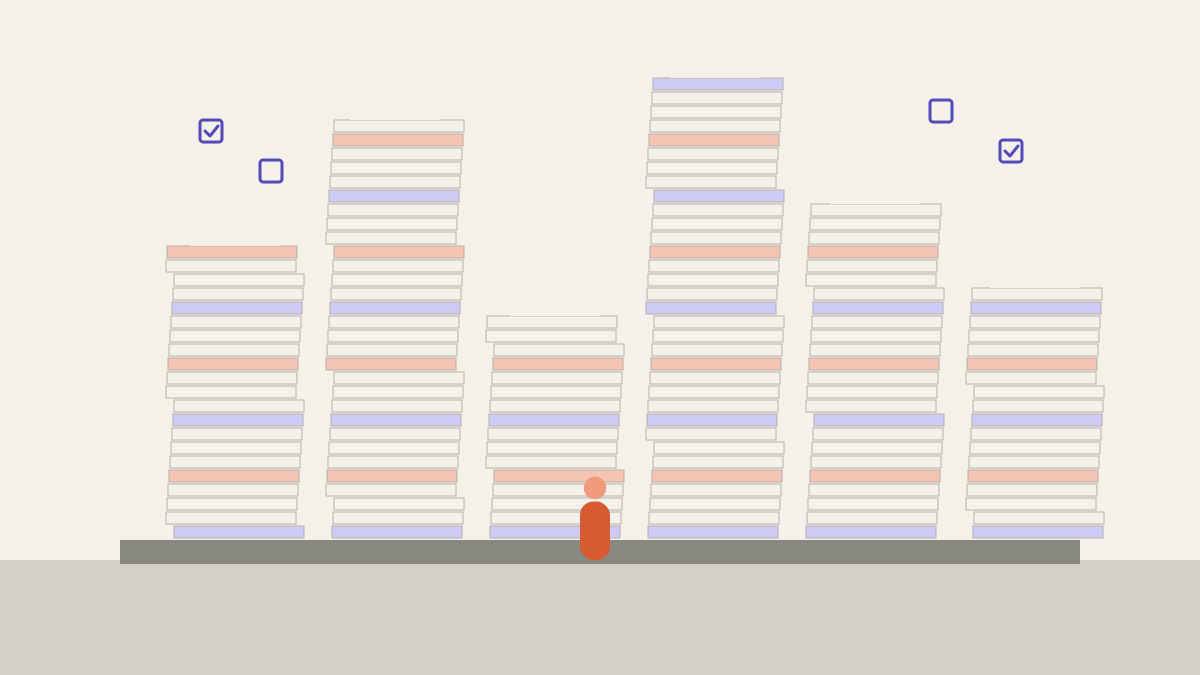
Every additional field adds a burden—and another place where someone can be held accountable.
There is another structural force that makes all this more stable, and that is the asymmetry of accountability. If an extra amount of money is given, there are data and records, and it can be traced back to the "error" of the specific person in charge; what should have been given was not given, and the people who were left out were not included in any reports, and no one complained, so there is no "error". After the system goes online, the former error becomes easier to trace, but the latter one remains traceless. It is not difficult to imagine what a rational grassroots worker would choose.
So, instead of correcting this asymmetry, a more sophisticated system makes it more stable.
What needs to be added is that translation is not just a loss. Those assessors and community leaders who have worked on this land for decades know which family's car has broken down and is parked in the yard, and which family's son has not been home for ten years. This is information that cannot be obtained in any database. The problem is not that the translators exist, but that the system pretends that the translators do not exist, and thus cannot exploit their knowledge or see their biases.
7. Back to the question: Is it a poor man’s surveillance system?
To say it is a "poor man's surveillance system" is to overestimate it.
It can indeed see some things, and it can see them clearly: exit records, vehicle registration, real estate information, and social security payments. These are behaviors that leave formal traces on a department. The girl in Ganzhou was seen because she applied for a pass, passed the customs, and left a record.
But it cannot see those who leave no trace: those who do not go out, do not surf the Internet, cannot fill out forms, cannot explain their situation, and cannot think of making a complaint. A disabled old man living alone in the village, an isolated family who had a falling out with his clan, and a person who didn't even know how to apply. They have no travel records or consumption records. They are blank in the data comparison, and this blank will not trigger any early warning.
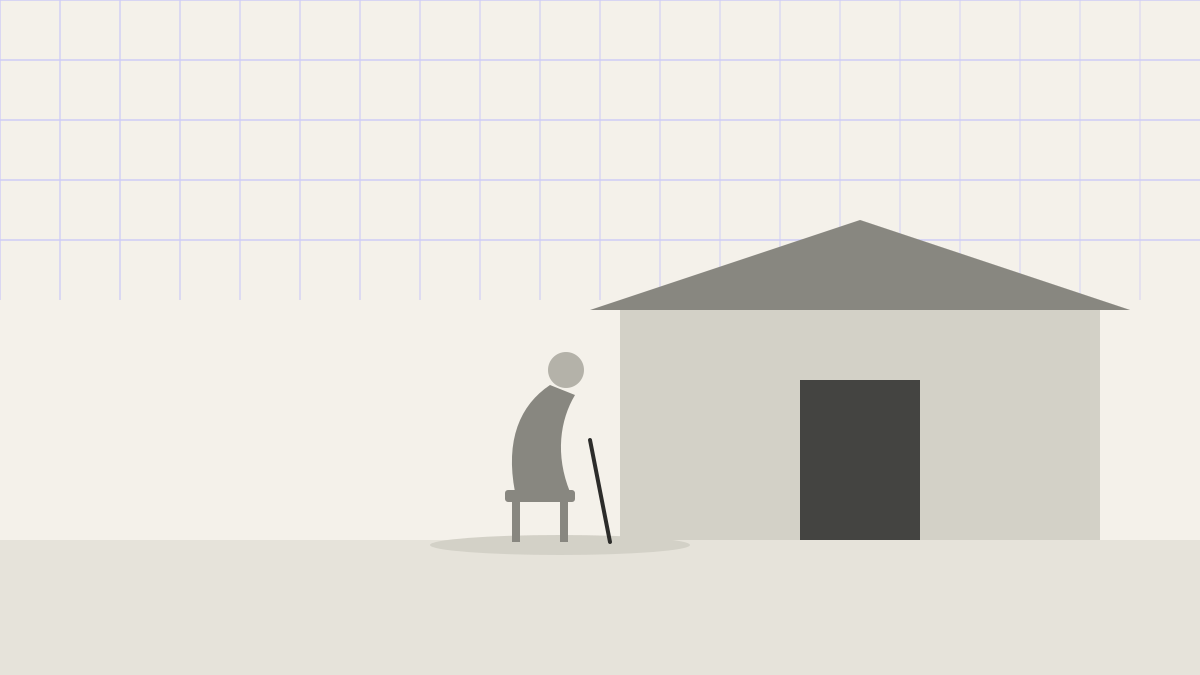
They have no exit record, and no alert is triggered.
There is another layer of irony: the system sees most clearly those among the poor who "will leave traces." The more dependent people are on the state, the more they abide by the rules, and the more their lives rely on various documents and registrations, the more transparent they will be in the system; the more people know how to leave no traces, the more invisible the system will be. When the subsistence allowance audit slides from auditing economic status to auditing consumption behavior, the people who are most clearly seen are often the poor who occasionally cross the line, rather than those who should not be included in the registration at all.
Therefore, the visible boundaries of this system are not determined by the server, database or comparison algorithm, but by those who stand between the system and life. As much as they can translate, the system can see; as much as they have no time to translate, are unwilling to translate, or cannot translate, the system will never see.
This makes me want to go back to the original question: What should such a system be?
One possibility is to use it as a monitoring tool: keep an eye on the data, keep an eye on the grassroots staff, and hold them accountable when problems arise. At the end of the road are more fields, more traces, more defensible records, and a system that is increasingly sophisticated but increasingly unclear.
Another possibility is to acknowledge the existence of this upper limit: the eyes of the system are the eyes of grassroots workers. Then what is really worth investing in is not just adding another layer of data comparison, but the eyes themselves: giving them enough time to listen to what an old man has to say; giving them enough protection so that they dare to make judgments, rather than just leaving impeccable traces; and allowing the system to see the differences between them, instead of pressing everyone into the same grid.
This is exactly what the term "decision support system" means: a system designed to support people making judgments, not to replace or monitor them. Nominally, most of these platforms are positioned in this way. Early warnings are just clues, and it is up to the person to make the judgment. But under an asymmetric accountability structure, it increasingly resembles the former in actual operation.
How much it costs to build a system depends on how much data it can store. And how much it can be seen in the end depends on how much time the dozen or so people have left to really take a look during the day when they are rushing between more than 800 families.
References
- The Beijing News, reprinted by Sina News, officially reported that "the minimum living allowance for the whole family will be cancelled if you go to Hong Kong to watch a performance", September 7, 2026: https://news.sina.com.cn/c/2026-09-07/doc-iniqyzxw5437385.shtml
- The Paper, "Girls going to Hong Kong to watch a concert will have their family's subsistence allowance cancelled?" Staff of the local Civil Affairs Bureau: Verifying now: https://www.thepaper.cn/newsDetail_forward_34022300
- Tencent News, "Ganzhou reports that "going to Hong Kong to watch a concert caused the subsistence allowance to be cancelled" Civil Affairs Department interprets the subsistence allowance verification rules": https://news.qq.com/rain/a/20260908A05XCB00
- Wenhui Commentary, "Watching a concert and losing the family's subsistence allowance?" In addition to legal principles, rescue management must answer questions of reason”: https://m.163.com/dy/article/L68HU3BJ05506BEH.html
- NetEase, "After listening to a concert, the subsistence allowance is gone: How poor must the poor be to deserve help?" 》:https://m.163.com/dy/article/L68IENRH05568CNH.html
- General Office of the People's Government of Hunan Province, "Implementation Opinions on Strengthening Dynamic Monitoring of Low-income Population and Implementing Stratified and Classified Social Assistance Work": https://www.hunan.gov.cn/hnszf/xxgk/wjk/szfbgt/202409/t20240909_33450684.html
- Fuxin Civil Affairs Bureau, "Plan on Further Strengthening Dynamic Monitoring of Low-income Population and Implementing Stratified and Classified Social Assistance Work Plan": https://mzj.fuxin.gov.cn/content/2025/967570.html
- Ban Yue Tan, "80.15 million people are included in the dynamic monitoring of the low-income population and the policy to assist the low-income population is upgraded": http://www.banyuetan.org/szjj/detail/20240520/1000200033135991716189065225969586_1.html
- Interpretation of the "14th Five-Year Plan for the Development of Civil Affairs Informatization": https://mzj.jiyuan.gov.cn/zcwenjian/zcjd/t763099.html
- General Office of the Central Committee of the Communist Party of China and the General Office of the State Council, "Opinions on Accelerating the Establishment of a Long-term Care Insurance System": https://www.mee.gov.cn/zcwj/zyygwj/202603/t20260327_1147747.shtml
- National Medical Security Administration, State Council Information Office press conference to introduce the situation of accelerating the establishment of long-term care insurance system, March 26, 2026: https://www.nhsa.gov.cn/art/2026/3/26/art_14_20034.html