

I wanted to buy an ice maker a while ago.
Open JD AI shopping and ask it for recommendations. He was very enthusiastic and listed a bunch of them, all worth upwards of one thousand yuan. The parameters are beautiful, the evaluation is beautiful, and the reasons for recommendation are written quite convincingly. Then I asked Claude the same question, and he pointed me to a Midea, priced at RMB 230, which had all the features I needed.
I finally bought the 230. Before buying, I went back to JD.com and asked its AI to calculate the discount for me - it worked very hard, with pop-ups, animations, and "optimized for you", which saved me 10 yuan. Putting these two numbers together,
, is basically all my experience of using AI to buy things in the past two years: The layer where it can cheat cost me an extra 770; the layer where it cannot cheat, it seriously saved me 10 yuan.
It didn't lie to me, it just didn't put that one in
Let me first say something fair for JD.com. Those ice machines that cost more than one thousand are most likely good machines, with better parameters, more genuine reviews, and completely reasonable recommendations. It didn't tell a single lie.
The problem is the candidate set.
It doesn’t need to say that 230 is not good, it just needs not to put it in. The boundaries of the candidate set never need to be explained to the user. You will never see a line of text telling you "I screened out 400 machines for you, and the screening logic is...". This is the deepest well of the recommendation system. The search era was here, but at that time it looked like a pit, like an advertising space, like sorting, and the interface was honest - you knew it was advertising.
Now it looks like a suggestion. "I recommend you buy this because it is xx." The credibility cost of this sentence is an order of magnitude higher than a search result list.
Thinking about this, there is an even more uncomfortable conclusion: the recommended price center of the platform AI is systematically higher than your actual optimal solution, because the unit price directly enters its KPI. This deviation is several hundred percent for cheap items, but only tens of percent for expensive items. The cheaper something is, the more it will be tricked by platform AI. It’s best to ask external AI for stuff that costs a few hundred dollars, but it’s not that urgent for stuff that costs a few thousand dollars.
Free is not the problem, the income structure is
My initial thoughts were very simple: Qianwen and JD AI are free, and I pay for Claude and GPT every month, so I believe in the latter.
later felt that this statement was untenable. Paying money doesn't create trust at all. You have paid for Prime, but the self-operated and advertising spaces are still in your face; you have also paid for Netflix, but the recommendation page still favors self-produced dramas.
What really makes me believe is another thing: Claude’s recommendation is wrong, and its income remains unchanged; if the recommendation is right, its income also remains unchanged. There is no pipeline between referral results and its cash flow.
The main revenue of JD AI is GMV. Even if it starts charging me 199 a year tomorrow, I still don't believe it - that 199 is a fraction of the relative commission. Therefore, the upper limit of the credibility of an AI shopping guide is not determined by whether it charges or not, but by its second largest source of income.
puts it more accurately: I don’t trust Claude, I trust its endorsement**.
It said that this machine works, which is what it guarantees, and it does not get any benefits. If it recommends it wrong, it will lose its reputation as a tool. If it recommends it correctly, it won't earn me a penny more - its only bet is "Will I still come and ask you next time?" This is a clean endorsement: there is no second beneficiary.
Jingdong AI said that this machine is good. There are at least two people standing behind this sentence: me and the seller of that machine. It might actually have my best interests at heart, but I'll never be able to confirm that. Once an endorsement has a second beneficiary, it is no longer an endorsement, but a promotion. This has nothing to do with whether it is right or not, nor does it have anything to do with whether its attitude is good or not.
I've been tricked before, but that trick didn't make me disbelieve it.
I have to say the opposite. I asked GPT to help me choose a printer, and it recommended a Toshiba 2323AMW for me. When I bought it, I found that it did not support Mac.
has overturned, completely overturned.
But strangely, this incident did not sway me at all. Because I can explain in one sentence what's wrong with it: there is no Mac driver. This is a specific, identifiable, single point of failure. And the responsibility can be divided down - I didn't say in the question that I used a Mac, and it didn't ask me back. What to do next time is also very clear: talk about the environment first, then the needs.
Now imagine that JD.com AI pushed the same one to me. It will say "This model has large printing volume, high cost performance and leading sales volume". I bought it and found it didn't work. Can I figure out what's wrong with it? No. It didn't lie, it just didn't mention it. And "didn't mention" is a perfect exemption structure - I can't even tell whether it doesn't know, or whether it knows but the commission is higher.
So my biggest experience in the past two years is actually this sentence: The value of AI shopping guide does not lie in how many mistakes it makes, but in whether it is wrong or not.
A system that is 90% correct but has unattributable errors will have lower long-term trust than a system that is 80% correct but has reproducible errors. Because every time the former is correct, you cannot confirm whether it is luck or ability.
The premise of "it's so wrong that it can be checked" is that it gives you the argumentation process. The premise of the argumentation process is that it does not make money based on what you buy - go back to it.
By the way, I think it is very important: The platform AI structure cannot give you the argumentation process, because the argumentation process is an attackable surface. Once it says "I recommend A because A's CADR is higher than B", you can immediately ask "Then why not recommend C, C is higher than A". And C may be a competing product, or it may be a white brand without advertising. The more it is said, the more it sounds like sales, not because it is stupid, but because it is risky to speak human words to it**.
So how to use it?
What I am doing now is to split this matter into two parts, rather than choosing one or the other.
The upstream is determined by specifications: What exactly do I want, which parameters are important, how to budget, and what pitfalls to eliminate.
Downstream is the execution of procurement: who is cheaper, how to stack the coupons, when to make the purchase, and who will pay for the after-sales service.
The key is that the bias of platform AI can only be hidden upstream, but not downstream.
If the coupons are not stacked, you will know the second you pay; if the goods have not arrived for three days, you will also know. This layer can be verified on the spot. It has no profit from cheating here. Instead, it has strong incentives to do the best - this is its moat. And "recommend you to buy A but not B" can never be verified: if you buy A, you will never know whether B will be better. This is a counterfactual and cannot be falsified. Prejudice must be deposited at this level, and only at this level.
So the rules are simple: Specifications are issued by people who do not rely on GMV to make money, and procurement is done by people with the ability to perform contracts.
asks Claude to come up with a spec—what parameters are required, what model range, and what to exclude—and then take this spec to JD.com or Qianwen for execution. You don't need to trust its taste, you just need its warehouse and its coupons. Downgrade it to a buyer, not a consultant. At this time, it doesn't matter whether it is free or not, whether it is biased or not, because you have already taken away the one area where it can cheat.
also has a side note that I think many people don’t realize: Taobao’s AI structure makes it impossible to tell you “This is 300 cheaper on JD.com”. For any category that requires cross-platform comparison, platform AI will naturally be eliminated. It's not that it can't work, it's that it can't.
In the past two years, Alibaba has been desperately trying to make Qianwen an entrance. What it is trying to prevent is not JD.com, but the fact that the dialog box has become an independent entrance. Because the downstream is hard work, costs, and there is no premium, and the upstream is the money.
AI also expires, and you can barely tell it
I didn’t understand this until I stepped on it.
I use Antelope's sound card. If you search now, the forums are full of complaints about unstable drivers, disconnections, and blue screens. You can search a lot of them and you will find conclusive answers. I use it every day and it's very stable.
Those posts are not fake. They were the truth once, but they were the truth ten years ago. After the popularity of USB class compliant, the driver hell of modern sound cards basically no longer exists. The same goes for the
microphone. Old forums will tell you that choosing wheat is to "choose orientation, taste, and character", which was true in the past. But in modern music production, this set has been greatly weakened. The logic of things like Sony C-80 is that the indicators are good enough, the price is low enough, and it is useful enough - the aesthetic premium is squashed by the workflow.
Then one thing became clear: categories will move on the coordinate axis, and in a single direction - as the market matures, they will all move towards "more parameterizable and more information-rich".
This brings out a fatal backlash for AI: Its corpus advantage is also its corpus lag.
The reason why it is ridiculously powerful on professional equipment is precisely because it has read ten years of forums-those things that are not available on the Chinese Internet and are hidden in Gearspace and old foreign posts. But in those ten years, the forums were full of "such-and-such sound card has a blue screen" and "such-and-such microphone lacks character". This corpus used to be truth, but now it is noise. A model that has read a lot of historical discussions will systematically treat solved problems as if they are still existing problems.
And this type of error is almost unnoticeable because it refers to a real discussion that has occurred and sounds extremely credible. The reliability of
AI in a category is inversely proportional to the migration speed of this category. Refrigerators and air conditioners, which have not changed much in ten years, are very stable; audio interfaces, graphics cards, and AI hardware, which change every year, may answer your questions today based on the consensus from five years ago. The actions corresponding to
are also very specific, and are different from the one above: for pitfalls outside the parameter table, you have to fix the environment; for pitfalls with expired corpus, you have to fix the timestamp - asking "Is this conclusion still valid now?" "What year was this consensus?" and "Has this problem been solved later?"
What things can be handed over to AI?
Pin the things I have bought in the past two years on a picture, it will probably look like this. The horizontal axis is the degree of parameterization of decision-making, and the vertical axis is the cost of information acquisition (the higher you go, the harder it is to check).
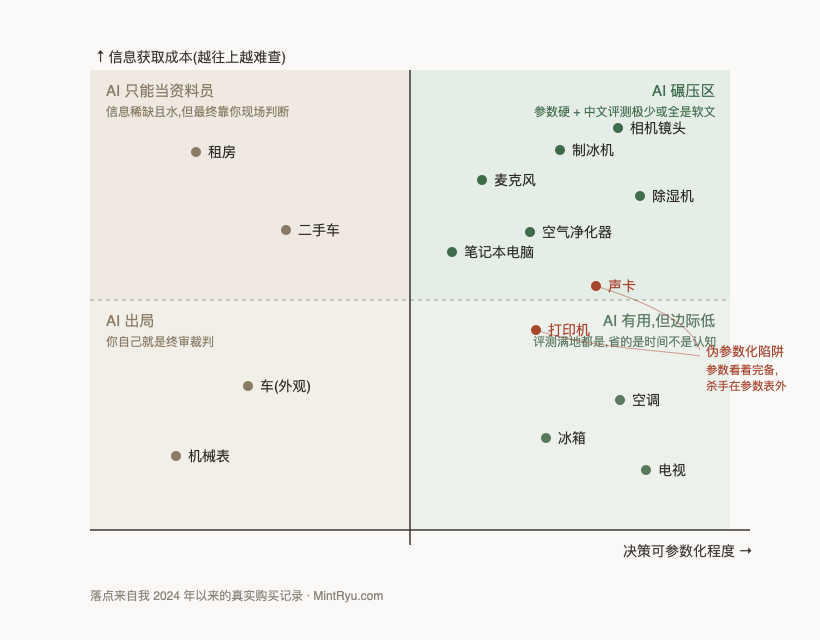
Upper right, AI crushing area. Ice maker, dehumidifier, air purifier, camera lens, microphone, sound card. The common point is that the parameters are hard, but the Chinese reviews are either very few or all soft articles. The value of AI here is not that it can calculate accurately, but that it has read things that you cannot read. This one has the best value for money.
lower right, effective but low margin. Air conditioning, refrigerator, TV. The parameters are just as hard, but there are reviews all over the place, and you can get it by yourself in half an hour. AI saves time, not cognition.
Upper left, can only be a document clerk. Rental house, used car. Information is scarce and watery, but the final judgment depends on on-site experience and luck. At most, AI can help you make a checklist.
Bottom left, out. The appearance of mechanical watches and cars. You yourself are the final judge, and your answer will change if you change your answer. There is one more layer to things like tables: the actual price is determined by the secondary market conditions, not pricing, and that information is fluid, non-public, and highly time-sensitive, and neither models nor searches can give it to you.
Then there are two points that I marked in red: Printer and Sound Card.
According to the coordinate axes, they should all be on the right side. The parameters look complete and AI should win. But each of them has a kind of killer that is not in the parameter list: the printer is the operating system and driver, and the sound card is (in the past) stability and LAN protocol. I call this the pseudo-parametric trap. Similar ones include graphics card power supply (chassis size), dishwasher (cabinet opening and water inlet), and projection (floor height and keystone correction).
An unreachable printer and a sound card have fallen into the same pit, which shows that this is not an unreliable manufacturer, but a structural problem. In this category, your question must first describe the environment and then the needs. I put the
laptop in the upper right middle. Its pain point is not that it is difficult to check, but that it is homogeneous - the parameters of the ten machines are almost the same, and the reviews all say the same thing, and you may not be able to tell them apart even if you watch them for three hours. What AI does here is to cut out irrelevant dimensions, telling you that there are only one or two that really widen the gap for your purpose.
Finally: It also helped me kill an option
Looking at cars last year, I went back and forth between Genesis G80, Volvo S90 and BMW 530. After comparing the parameters, price, value retention rate, and reputation, I still can’t make a decision.
GPT said: Since you don’t like the appearance of S90, just kill this option. After buying the car, it looks unpleasant and unlucky every day. The
problem was solved on the spot. The interesting thing about
is that it doesn't tell me anything I don't already know. I already knew I didn't like the look. What it does is to upgrade the judgments I already have into hard constraints. The reason why I'm still struggling is because I don't think the reason for giving up a car that is qualified in all aspects just because it doesn't look good is not valid enough. I'm waiting for someone to sign for me. It's signed. The
car clearly falls into the "AI out" bracket in my picture. The reason is that aesthetics cannot be parameterized. But it still helped me in this area - it didn't judge for me, it recognized that my judgment was final and then helped me execute it.
So AI actually has three values in buying things, not just one: information (it has read what you cannot read), execution (it counts coupons and grabs goods for you), and decision hygiene (it helps you throw away what you should throw away). The first two can be assigned to different people, and the third can only be done by the one that does not make money from what you buy - the AI of a platform will never advise you to cross out a car from the candidate.
Finally, I have to be honest: I do not represent users.
The number of people who will outsource shopping decisions to LLM in 2024 may be less than one in 10,000 in China. I have the ability to pay, I have English skills, and I am willing to spend time talking about parameters in a dialog box. JD.com and Taobao serve more than one billion e-commerce monthly users. For that market, "non-auditability" is not a problem at all, "saving trouble" is enough - just like everyone knows that Douyin is fed by algorithms, but they still browse for eight hours.
So I don’t think the platform AI will lose. I think this matter will split into two markets: one wants to save trouble, and the other wants to be able to investigate. The former will be much larger.
In the past two years, I have basically gone from renting a house and eating to buying computers, cars, watches, and appliances. What I was really handed over was never the decision-making power, but the two drudgery tasks of checking information and listing conditions. And the reason why I dare to submit it is because the endorsement is clean - every word it says for me has only me as the beneficiary.
I just want people who should be in the latter market to stop staying in the former market and spend the extra 770 yuan, and still be moved by the 10 yuan saved.